
Introduction
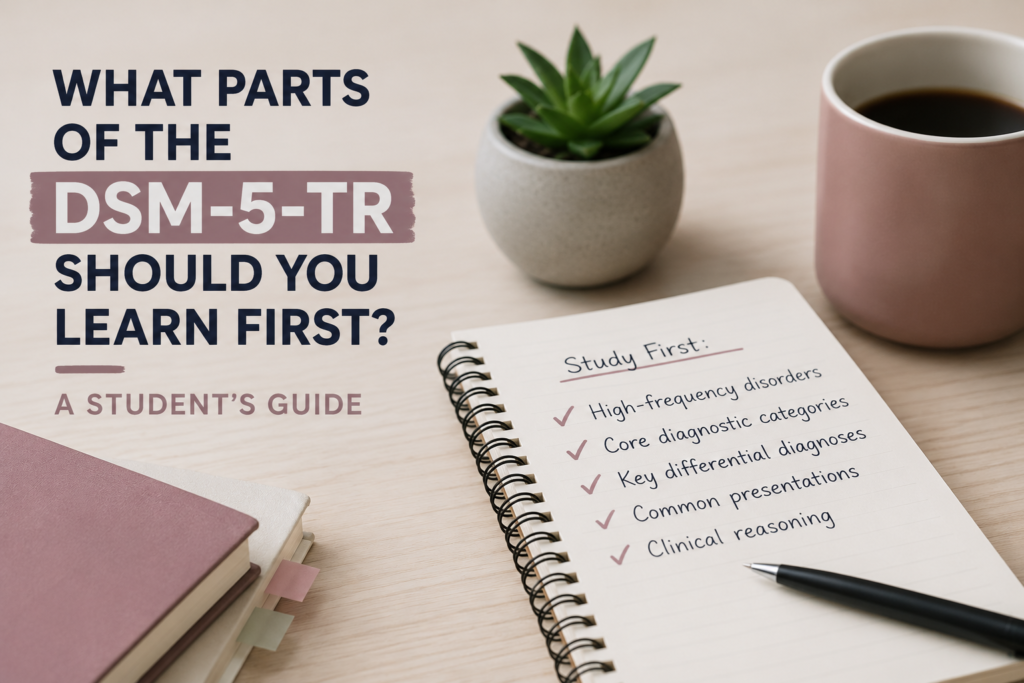
What to study first in the DSM-5-TR is one of the first questions many psychology students ask.
The manual contains hundreds of diagnoses, dozens of diagnostic categories, and thousands of pages of information. Faced with that amount of material, it’s easy to assume that the only solution is to start on page one and keep reading.
That approach rarely works.
The DSM wasn’t designed to be read like a traditional textbook. It’s a diagnostic manual that becomes much easier to use once you understand how it’s organized and what deserves your attention first.
If you’re completely new to the DSM, you may want to begin with our Beginner’s Roadmap to the DSM-5-TR, where we explain how the manual is structured before diving into specific study strategies.
If you’ve already decided that reading the DSM from beginning to end isn’t the most effective strategy, the next question is usually: what should you study first?
In our previous article, How to Study the DSM-5-TR Without Reading It Cover to Cover, we explained why the DSM works better as a reference manual than as a traditional textbook. This guide builds on that idea by helping you decide where to begin.
This article focuses on something more practical:
If you had only a few weeks to build a solid foundation, what should you learn first?
Start by Understanding the Structure, Not the Disorders
Many students immediately begin memorizing diagnostic criteria.
That’s understandable.
Criteria feel like the “real content.”
In reality, learning the overall structure of the DSM first makes every diagnosis easier to place later.
Instead of thinking about hundreds of unrelated disorders, start by becoming familiar with the major diagnostic categories.
Ask yourself questions like:
- How is the DSM organized?
- Which categories are most common in clinical practice?
- Which disorders are likely to appear during training?
At this stage, don’t worry about remembering every criterion.
Focus on building a mental map.
Once you know where information belongs, adding details becomes much easier.
Learn the High-Frequency Disorders First
Not every diagnosis deserves the same amount of attention during your first pass through the DSM.
Some disorders appear repeatedly in coursework, exams, supervision, and introductory clinical cases.
These are often a better investment than spending hours studying rare conditions early on.
Examples include disorders within categories such as:
- Depressive Disorders
- Anxiety Disorders
- Obsessive-Compulsive and Related Disorders
- Trauma- and Stressor-Related Disorders
- Bipolar and Related Disorders
Learning these areas first gives you a practical foundation that you’ll continue building throughout your training.
Study Categories Before Individual Diagnoses
A common mistake is treating every diagnosis as a separate topic.
Instead, learn families of disorders together.
For example, study anxiety disorders as a group before trying to memorize each diagnosis individually.
This helps you recognize both similarities and differences from the beginning.
You’ll naturally start asking better questions:
Why is this Generalized Anxiety Disorder instead of Panic Disorder?
What separates Social Anxiety Disorder from Avoidant Personality Disorder?
Those comparisons are exactly where clinical reasoning begins.
Don’t Memorize Every Criterion Yet
One of the biggest DSM study mistakes is believing you need perfect recall before moving forward.
You don’t.
Early in your learning, your goal should be recognition rather than memorization.
Try to understand:
- the typical presentation
- common symptom clusters
- duration requirements
- functional impairment
- the disorders most likely to be confused with one another
The detailed wording of every criterion becomes much easier once the overall picture is already familiar.
If you’ve caught yourself trying to memorize everything at once, our article 5 Common DSM Study Mistakes Psychology Students Make explores why that strategy often creates more frustration than progress.
Begin Comparing Disorders Earlier Than You Think
Many students postpone differential diagnosis until much later.
That usually slows learning.
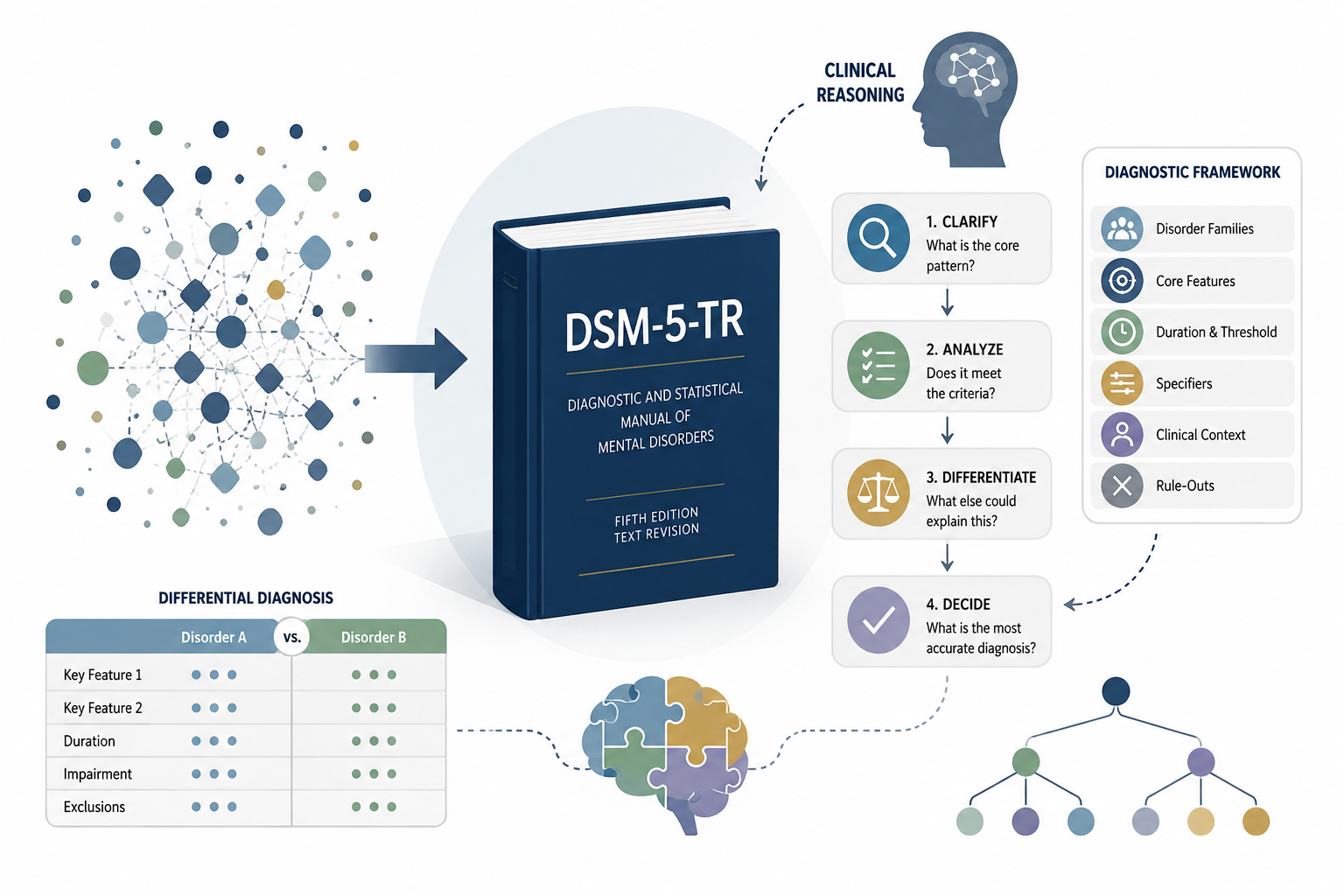
Comparison is one of the fastest ways to understand the DSM.
Instead of studying Major Depressive Disorder today and Persistent Depressive Disorder next month, compare them during the same study session.
Do the same with:
- OCD and Generalized Anxiety Disorder
- Panic Disorder and Social Anxiety Disorder
- Bipolar Disorder and Major Depressive Disorder
The differences become much easier to remember when you see them side by side.
Build a Study Sequence You Can Repeat
Rather than jumping randomly between chapters, use the same sequence every time you approach a new disorder.
For example:
- Identify the diagnostic category.
- Learn the overall presentation.
- Review the core diagnostic criteria.
- Compare it with similar disorders.
- Read one or two brief clinical cases.
- Review the differential diagnosis.
Repeating the same process reduces cognitive overload and creates consistency in your study sessions.
A Visual Approach Can Make the Process Easier
Many students discover that the hardest part of studying the DSM isn’t reading the information.
It’s organizing it.
Visual comparison tables, symptom summaries, diagnostic flowcharts, and side-by-side disorder comparisons can make the manual much easier to navigate.
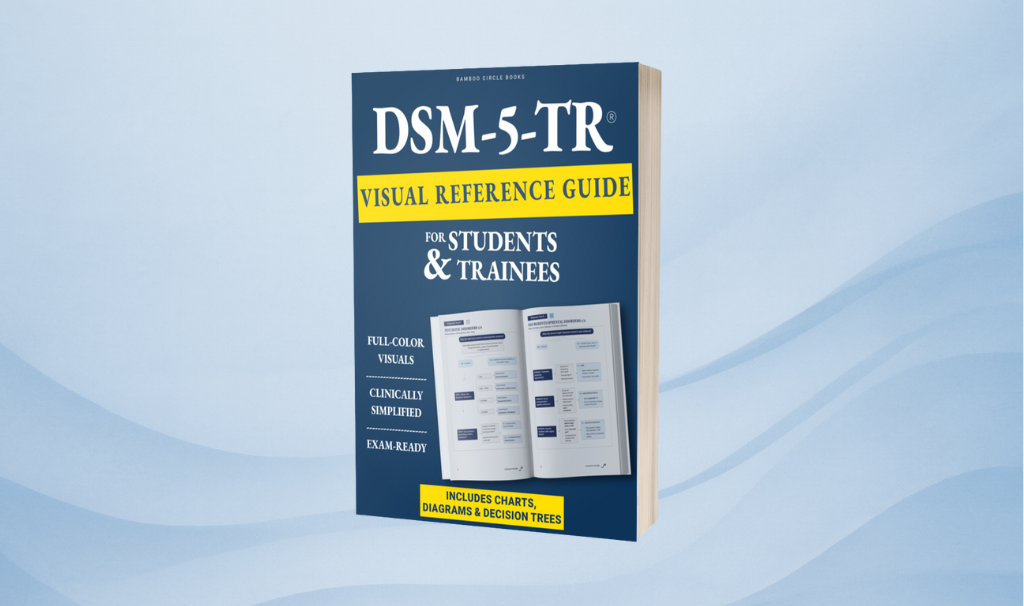
That’s the idea behind our DSM-5-TR Visual Guide, which was designed to help students move from memorization toward clinical reasoning through structured visual learning.
Final Thoughts
Knowing what to study first in the DSM-5-TR can save weeks of unfocused reading.
Start with the structure.
Focus on the disorders you’ll encounter most often.
Study categories before isolated diagnoses.
Compare similar conditions from the beginning.
Most importantly, don’t measure your progress by how many pages you’ve read.
Measure it by how much more confidently you can explain why one diagnosis fits better than another.